
National Service Projects
ICHEC's National Service provides three different project classes (A,B,C) with differing resource allocations, review levels and indicative review turnaround times. Class C is the smallest, normally used for benchmarking which will determine the next steps. Class B is at most 10x larger and would be the normal type of project. Class A projects are 10x bigger still and have the greatest scrutiny. Class C projects are on a rolling call and are reviewed by ICHEC staff. Class A,B projects are on a fixed call and are also reviewed by Irish researchers in the same field.
Applicants should be aware that:
- Grant award details, where applicable, are recorded for applications.
- Where the grant holder is the PI and is a post-doc, only their name need appear on the applications.
- Where the grant holder is the principal of the research group but the applicant is a post-doc both names should appear on the application.
- Previously reviewed proposals, which have attracted major funding, should be explicitly flagged by grant details and PI name.
- For more details on the fixed call see the table below.
- For new comers you are encouraged to visit or establish contact with ICHEC personnel, to ensure efficient methodology and best use of resources. Typically it is recommended that you start with a class C.
At the bottom of this page are the documents you need to submit an application, the Terms of Use (TOU) and an application template (case document). Finally there is a PDF with the full description of the current policies.
Ahead of new proposal submission and in accordance with the ICHEC Acceptable Usage Policy, applicants should notify ICHEC of all publications arising out of work completed with the help of ICHEC from past projects. Simply email the Helpdesk with the publication reference and link to the online version.
Project Classes
As of 01/09/2025, Class A and Class B projects operate under fixed call deadlines while Class C projects continue on a rolling call basis. Project applications can be submitted at any time but Class A and Class B award decisions will be made according to the call schedule in the table below:
Proposal Submission Deadline | Technical Review Completed | Scientific Review Completed | Decision Communicated | Project start |
|---|---|---|---|---|
1/09/2026 (B only) | 10/09/2026 | 5/10/2026 | 9/10/2026 | 16/10/2026 |
1/12/2026 (A and B) | 10/12/2026 | 25/01/2027 | 29/01/2027 | 5/02/2027 |
1/04/2027 (B only) | 9/04/2027 | 10/05/2027 | 14/05/2027 | 21/05/2027 |
1. Class C project: Discovery
Class C projects are intended to provide fast access to modest resources with less review overhead. They have multiple possible uses including:
- Introductory access for inexperienced HPC users
- Exploratory access for researchers who need to develop, port, optimise or benchmark codes
- Benchmarking simulations and to assess resources needed for the scientific goals.
Class C project applicants should note that the maximum resource levels are modest and will be exhausted very quickly if larger scale runs are performed. They are on a rolling call.
Resources and Considerations
Max. Normalised Node Hours:       2,500 node-hours
Max. Storage:                     1000 GB
Duration:                         3-6 months
Target Review Turnaround Time:   1 week
Proposal:                        2-3 pages
Applicants:     Group Leader/Professor/Lecturer/Post-doc
2. Class B project: Regular
Class B projects are intended for the needs of the majority of the research community. Typically applicants will be small research groups or individual researchers. Successful applications are expected to lead to referred publications.
No more than 3 concurrent Class B projects from any one PI will be supported. Only 1 application can be made per PI to a particular call and the requested resources may not be allocated in full to a successful project application depending on availability.
Resources and Considerations
Max. Normalised Node Hours:      25,000 node-hours
Max. Storage:                    4000 GB
Duration:                        12-18 months
Proposal:                         4-5 pages
Applicants:     Group Leader/Professor/Lecturer/Post-doc
3. Class A project: High Impact
Class A projects are intended for consortia concerned with high impact problems. These groups will require resources representing a substantial fraction of the centre's resources over a long period of time. Successful applications are expected to yield high-impact scientific publications. Only 1 application can be made to a particular call and the requested resources may not be allocated in full to a successful project application depending on availability.
Class A project project applicants are expected to have a good knowledge of the characteristics of the code(s) which they intend to use - such as scalability properties - before writing their proposal. For this reason, applicants who are not in such a position are advised to first apply for an exploratory Class C project in order to undertake a basic scalability and performance study. Such an exercise is essential to provide an accurate estimate and a proper justification of the resources requested. If you intend to use packages supported by ICHEC, you may contact us via the Helpdesk as we can assist you in this task.
A 'light touch' interim project report and material for inclusion in ICHEC annual reports may be requested as a requirement for continued resourcing. A more substantive report again for inclusion in annual reports may be requested at the end of a project.
Not all calls accept class A applications. Only 1 concurrent project is allowed.
Resources and Considerations
Max. Normalised Node Hours:      250,000 node-hours
Max. Storage:                    10000 GB
Duration:                        18-24 months
Proposal:                         6-10 pages
Applicants:     Group Leader/Professor/Lecturer
Resource Allocation on Meluxina
Compute resources on Meluxina are allocated separately for CPU, GPU and Large Memory nodes. If a mix of resource types are required they can be allocated with a weighting of CPU : GPU : LMN = 1 : 3.37 : 4.36.
The following equation should be used to calculate and check that the Normalised Node Hours requested does not exceed 250000 , 25000 , 2500 for Class A, Class B and Class C projects respectively.
Normalised Number of Node Hours Requested =
                         Number of CPU Node Hours +
                        (3.37 x Number of GPU Node Hours) +
                        (4.36 x Number of Large Memory Node Hours)
Review Process
All the applications submitted through the National Service are subject to a technical evaluation carried out by one of our computational scientists in order to verify the technical viability of the project and that:
- CPU/GPU time requested is appropriate
- Storage does not exceed the class project limits
- Software is installed and available for the applicant
- Simulation's plan is in agreement with Meluxina scheduling policies
- Any special requirement is needed
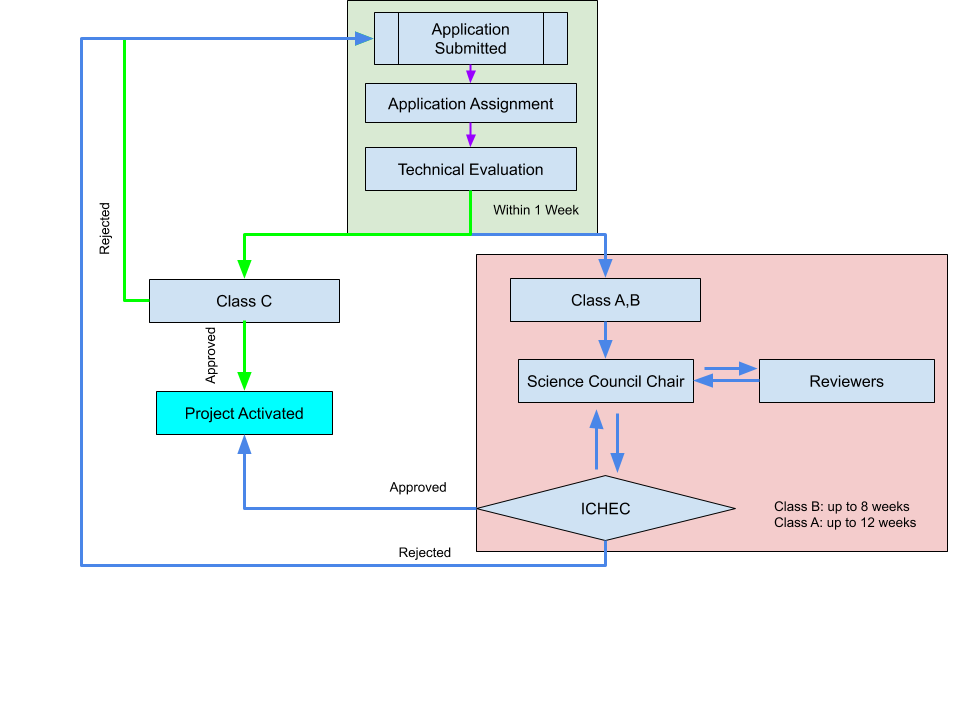
After the technical evaluation, Class C applicants are notified and their respective projects are activated. In the case of Class A and B applications, after the technical evaluation, projects are sent out to the Science Council for assessment prior to the scheduled evaluation and allocation meeting.
| Attachment | Size |
|---|---|
| LuxProvide Terms of Use | 154.5 KB |
| Current Policies | 131.99 KB |
| Project Application Template | 106.5 KB |